摘要
研究了具有参数不确定性的非线性分数阶系统的输出反馈控制问题. 为此, 首先提出一种新颖的分数阶比例积分(PI)观测器对未知状态进行估计, 利用拉普拉斯变换和Gronwall-Bellman不等式得到观测器误差系统渐近稳定的充分条件; 随后, 基于分数阶Lyapunov稳定性定理研究系统的输出反馈控制问题, 并分析相应闭环系统的渐近稳定性; 最后给出了具体的数值仿真算例, 从而说明本文所得理论结果的有效性和适用性.
Abstract
This paper is concerned with the output feedback control problems of nonlinear fractional-order systems involving parametric uncertainties. Toward this aim, we first propose a novel fractional-order proportional integral (PI) observer to estimate the unknown state of the considered system. Sufficient conditions for asymptotical stability of the resulting observer error systems are then obtained by using the Laplace transformation and the Gronwall-Bellman inequality. Subsequently, output feedback control problem of the studied system is considered and asymptotic stability of corresponding closed-loop system is derived based on the fractional Lyapunov stability theorem. At last, to illustrate the effectiveness and practical applicability of our obtained theoretical results, we provide a detailed numerical example.
1 Introduction
Fractional-order systems are capable of modeling many processes in science and engineering with greater accuracy than integer-order systems [1-4]. The reason is that the fractional-order derivative in fractionalorder systems is defined as a kind of convolution hence representing well the dynamics inheriting memory and hereditary properties where integer-order derivative approaches appear to fail [5]. These applications encompass physics [6], biology [7-8], electrochemical processes [9] and engineering [10-12]. Over the last two decades, numerous advanced control approaches have been utilized to control or synchronize fractionalorder systems, which include feedback control [13-14], adaptive control [15], sliding mode control [16] and event-triggered control [17], etc. Among them, feedback control is one of the central problems in control theory and applications. Since almost all practicalcontrol systems are affected by uncertainties and are also essentially nonlinear, there has been an increasing interest in feedback control of uncertain nonlinear fractional-order systems. For example, in reference [18], a robust fractional-order dynamic output feedback sliding mode control technique was introduced for uncertain fractional-order nonlinear systems. To handle unknown nonlinear functions and unmeasured states, neural networks and K-filters were incorporated into the design of output feedback controllers [19]. Additionally, a low-complexity adaptive fuzzy output feedback control scheme was proposed based on the backstepping method, effectively addressing the problem of complexity explosion without the need for extra command filters or auxiliary dynamic surface control techniques [20]. Most of these approaches utilized fuzzy logic systems or radial basis function neural networks as universal approximators, though the application of these methods typically yields only semiglobal results. However, available literature lack sufficient works addressing this problem in uncertain fractional-order systems, a gap that motivates our current study.
It is worth noting that in some practical applications, the system state can’t be measured directly. Under the limitation of unmeasurable state, feedback control can’t be carried out smoothly. For dealing with this, a common way is to propose an observer to estimate the system states. The approach involves state estimation through a fractional sliding mode observer, as discussed in reference [21], which addressed a class of uncertain nonlinear fractional-order systems. However, there are some limitations for the application of this approach, it is that the approach is based on replicating the system resulting in redundant estimation of variables that are already known. To overcome these challenges, recent research has introduced innovative approaches. A nonredundant observer is proposed for nonlinear fractionalorder systems under parametric uncertainties, offering a new reduced-order perspective [22]. The key feature of the observer proposed in reference [22] is that it can be model free and only focuses on estimating the unmeasurable state of studied system. This is appealing in applications. For example, in infectious disease modeling, only estimating the number of susceptible population via affected population is surely cost saving.
Motivated by these above considerations, the purpose of this paper is to investigate the output feedback control problems of nonlinear fractional-order systems with parametric uncertainties. To begin with, we design a fractional proportional integral (PI) observer in the framework of the unmeasurable premise variables. A reasonable output feedback control scheme is then developed to stabilize the considered uncertain nonlinear fractional-order systems. This approach offers three distinct advantages.
1) A new fractional PI observer for the uncertain nonlinear fractional-order systems with parametric uncertainties is designed by using the fractional algebraic observability condition (FAOC) .
2) This observer is model-free and is also of reduced order, necessitating the design of a separate observer for each variable to be estimated, making it non-redundant.
3) We present a new contribution on the PI observer-based output feedback control of nonlinear fractional-order systems with parametric uncertainties using a generalization of Gronwall-Bellman lemma and the fractional Lyapunov method.
The rest of this paper is organized as follows. In Section 2, we formulate our problems and give some preliminary results to be used thereafter. In Section 3, we address the stability of corresponding observer error system. The design procedure for the stabilizer is then discussed in Section 4. Section 5 considers a numerical example.
2 Preliminaries and problem formulation
Definition 1 [5] Let α >0 be a real number and denote L1 [0, T] the space of summable function on [0, T]. The operator defined on L1 [0, T] by
(1)
is called Riemann-Liouville fractional integral operator of order α if its right side is pointwise defined. Heredenotes the Gamma function.
Definition 2 [5] Let α ∈ (0, 1]. Then the Caputo fractional derivative of order α of a function ϕ ∈ C[0, T] is defined by
(2)
Lemma 1 [23] Letbe a vector of differential function, then for any t >0, the following inequality
(3)
holds, whereis a constant, symmetric and positive definite matrix and x T denotes the transpose of x.
Lemma 2 [24] Ifis an arbitrary real number, µ satisfies πα/2 <µ <min{π, πα}, some constant C >0 can be found such that
(4)
wheredenotes the eigenvalues ofanddenotes the l2-norm.
Lemma 3 [25] (Gronwall-Bellman lemma) Let φ, h be two bounded nonnegative measurable functions and g be a nonnegative integrable function on [t0, t1]. If the following inequality
holds, then
(5)
is satisfied for all t0 ≤ t ≤ t1. Moreover, if in addition, h (t) is nondecreasing, we have
(6)
Lemma 4 [26] Let x, y be two real vectors of the same dimension. Then, for any scalar ψ >0, the following inequality holds true:
(7)
Throughout this paper, let us consider the following nonlinear fractional-order system:
(8)
whereis the state vector, denotes the Caputo fractional derivative, is a constant matrix anddenotes the nonlinear function. Besides, represents the control input, is the constant matrix, is the initial condition, is the system output and h (·) is a continuous function.
Notice that in a physical system, it is not always possible to measure all values of system state and the unknown states can be represented by a new auxiliary variable. For system (8) , suppose that the new variable is ζ. In what follows, we focus on considering the nonlinear fractional-order systems of the following form:
(9)
wheredenotes unknown state, is the known state, is the known function, are control inputs andare two constant matrices. Hereis necessarily required for our afterwards design. Besides, are two known matrices andis the uncertainty that will be specified later.
This paper aims to address the observer-based output feedback control problems for uncertain nonlinear fractional-order system (9) . The detailed design process is illustrated in Fig.1. For this purpose, the following assumptions on the nonlinear function F (X (t) , ζ (t) ) and ∆ (X (t) , ζ (t) ) are needed.
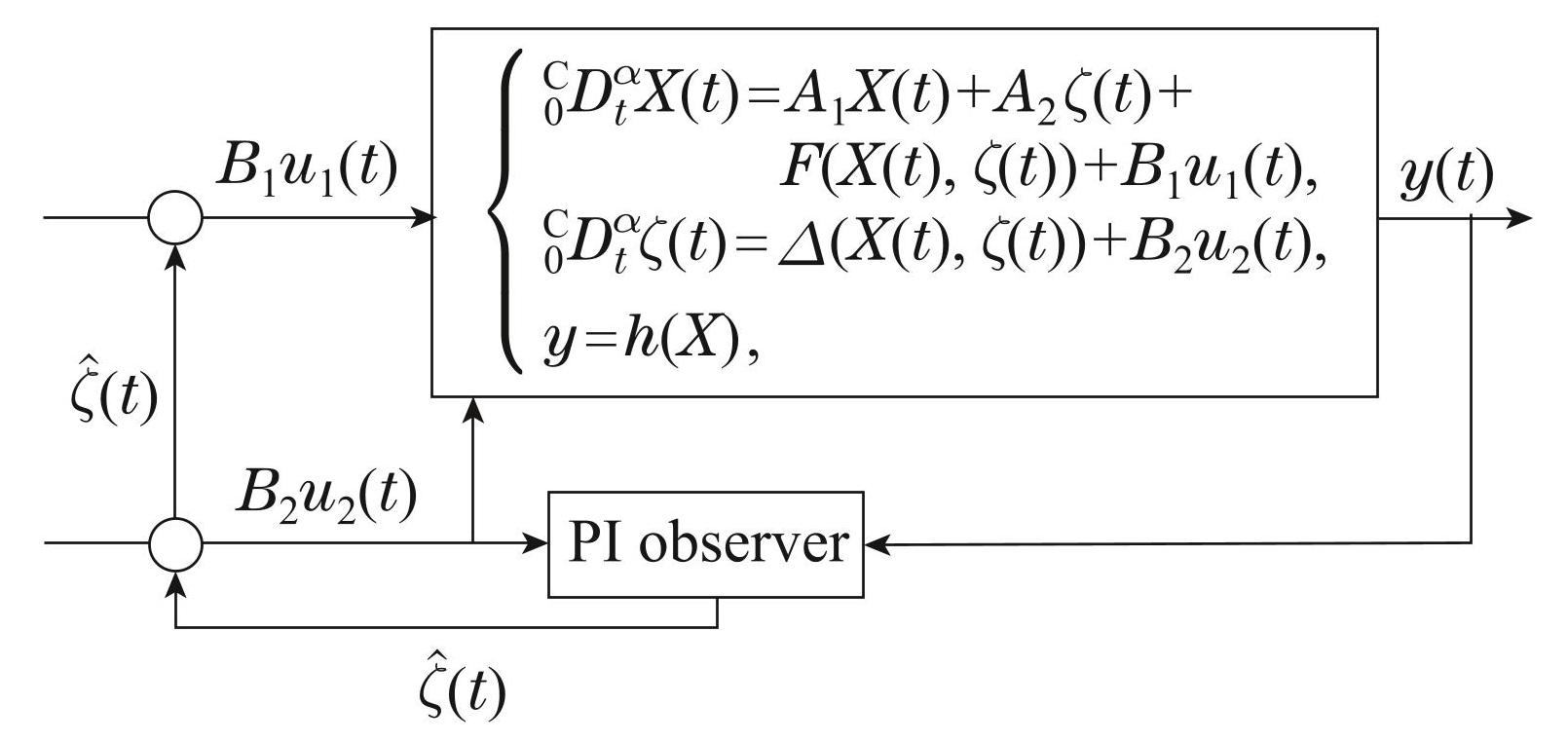
Fig.1Block diagram for output feedback control of system (9)
Assumption 1 F (X (t) , ζ (t) ) , ∆ (X (t) , ζ (t) ) are Lipschitz continuous in ζ (t) , i.e.,
(10)
(11)
and F (X (t) , 0) = 0, ∆ (X (t) , 0) = c3, where c3 ∈ is a constant vector and c1, c2 >0 are two constants.
Before presenting our main results, the following definition on unknown function ∆ (X (t) , ζ (t) ) to guarantee the existence and uniqueness of solution is needed.
Definition 3 [27] If a state variable ζi is a function of derivatives of the available output y, i.e.,
where φi is a continuous function, then ζi satisfies the FAOC.
Based on the FAOC, if an unknown state variable can be written with respect to the output y and its fractional derivatives, an auxiliary variable can then, be proposed to represent it so as to remove the dependence of these unmeasurable signals.
3 PI observer for state estimation
Based on above FAOC, to estimate these unknown states, in this section, we consider the following PI observer:
(12)
whereis the estimation of ζ (t) , κ (t) is the fractional integral part of and l1i, l2i are two positive constants. Moreover, let be the error signal. By Eqs. (9) (12) , the observer error system is given by
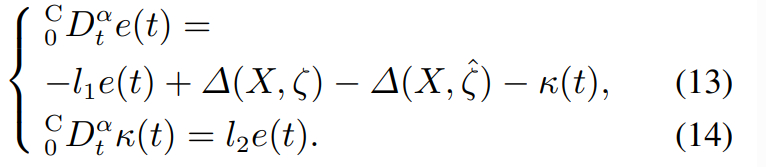
To clearly present our main results, we rewrite Eqs. (13) – (14) as the following vector formulation:
(15)
by setting
Now we are ready to establish the following theorems.
Theorem 1 If state variable ζi satisfies the FAOC,
(16)
and Assumption 1 is fulfilled, then fractional-order system (12) is a fractional PI observer for the unknown dynamics (9) , and the corresponding observer error system (15) is asymptotic stability.
Proof Using the Laplace transformation and Laplace inverse transformation, we get the following solution of Eq. (15)
(17)
By the Assumption 1, one has
Using the norm operator on both sides of Eq. (17) , it then, follows from Lemma2 that there exist constants θ >0 such that
According to Lemma 3, we obtain the following result by applying the Gronwall-Bellman inequality
As t approaches infinity, the norm of asymptotically tends to zero if This yields that the observer error system (15) is asymptotically stabile and our proof is finished.
4 Observer-based output feedback control
The purpose of this section is to study the output feedback control problem of uncertain nonlinear fractional-order system (9) with fractional PI observer (12) and the following feedback control laws
(18)
(19)
where are feedback gains to be determined and c3 is defined as in Assumption 1.
Theorem 2 Suppose that all conditions of Theorem 1 are satisfied. Then, the fractional-order system (9) with PI observer (12) and the state estimated feedback (18) – (19) is globally asymptotically stable provided that the inequality
(20)
with and holds true.
Proof By substituting the formula (18) – (19) into the original system (9) and combining it with formulas (13) – (14) , we obtain the corresponding closed-loop system as follows:
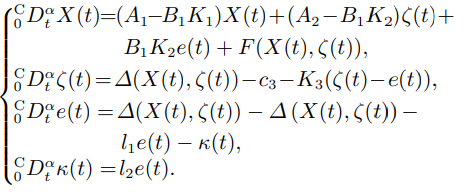
To analyze the stability of this closed-loop system, by setting
(21)
and substituting c3 with ∆ (X, 0) , we see the following system:
(22)
where
(23)
(24)
Consider the following Lyapunov function candidate
from Lemma1 and Assumption 1, the fractional derivative of order α of the V (t) is then, given by
(25)
According to Lemma4 and Assumption 1, we see that
Let and It follows that
Therefore, if we choose K1, K2, K3, l1, l2 to satisfy
(26)
it can be concluded by fractional Lyapunov stability theory that the output feedback controller composed by Eqs. (12) (18) – (19) can globally asymptotically stabilize the nonlinear system (9) .
5 An example
To illustrate the effectiveness of our theoretical results, we examine the fractional generalization of the RÖssler hyperchaos equation [28] as a practical exam-ple. The system under investigation is given by
(27)
where ζ1 = x3, ζ2 = x4, α∗ = 0.95, a = 0.25. We set initial conditions as {x10, x20, x30, x40} = {−10, 20, −15, 15}. Fig.2 shows that the evolution of the system exhibits a hyperchaotic attractor.

Fig.2Rossler hyperchaos system
Unknown variables is assumed to satisfy the FAOC and we can represent them using known variables and their derivatives as follows:
(28)
(29)
By substituting Eqs. (28) – (29) into Eq. (12) , we obtain
(30)
(31)
To completely eliminate these inaccuracies for directly calculateandwe introduce the following auxiliary variables:
(32)
(33)
(34)
(35)
and set [u11 u12 u21 u22] = [0 0 0 0]. By algebraic manipulations, we can get the fractional PI observer for ζ1 and ζ2 and then combine the observers for the two unknown variables, which lead to the following results:
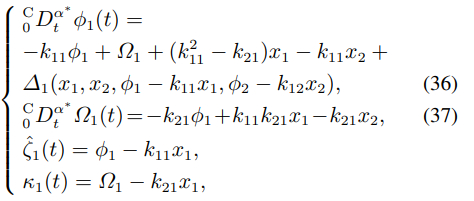
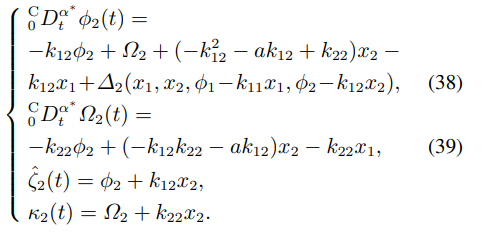
Next, we proceed to calculate the parameters of the Luenberger observer as follows:
(40)
(41)
where:
(42)
(43)
(44)
Choose
which yields that (A + LC) is Hurwitz. For the PI observers (37) – (39) , set the gains as [k11 k21 k12 k22] = [40 20 200 20] with initial conditions ϕ1 = k11x1, Ω1 = k21x1, ϕ2 = −k12x2, Ω2 = −k22x2. These initial conditions mean thatThe following cost functional is considered as a performance index for assessing the accuracy and efficiency of the estimator:
(45)
Fig.3 displays the estimated values from both the Luenberger and PI observers alongside the true value x3. Notably, within the time interval of 0∼0.6 seconds, the PI observer exhibits faster convergence towards the true value. From Fig.4, it becomes evident that the estimation error of the PI observer consistently remains smaller than that of the Luenberger observer during the final time period, from 29.9 s to 30 s. The trend observed in Fig.5 and Fig.6 reinforces these results, providing clear evidence of the practicality and efficiency of the PI observer. As a non-redundant observer, it contributes to cost savings.
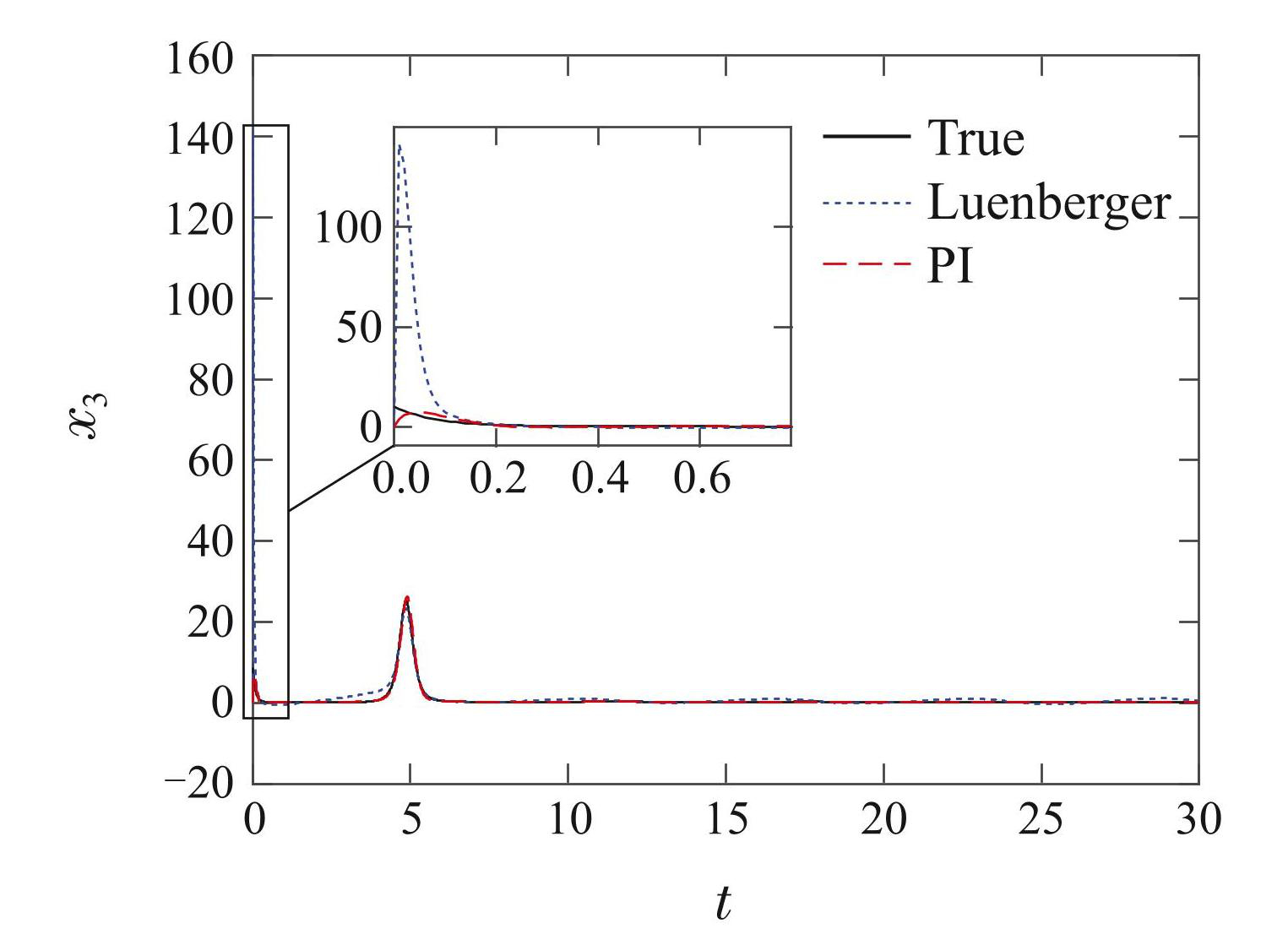
Fig.3State x3 and its estimatesand
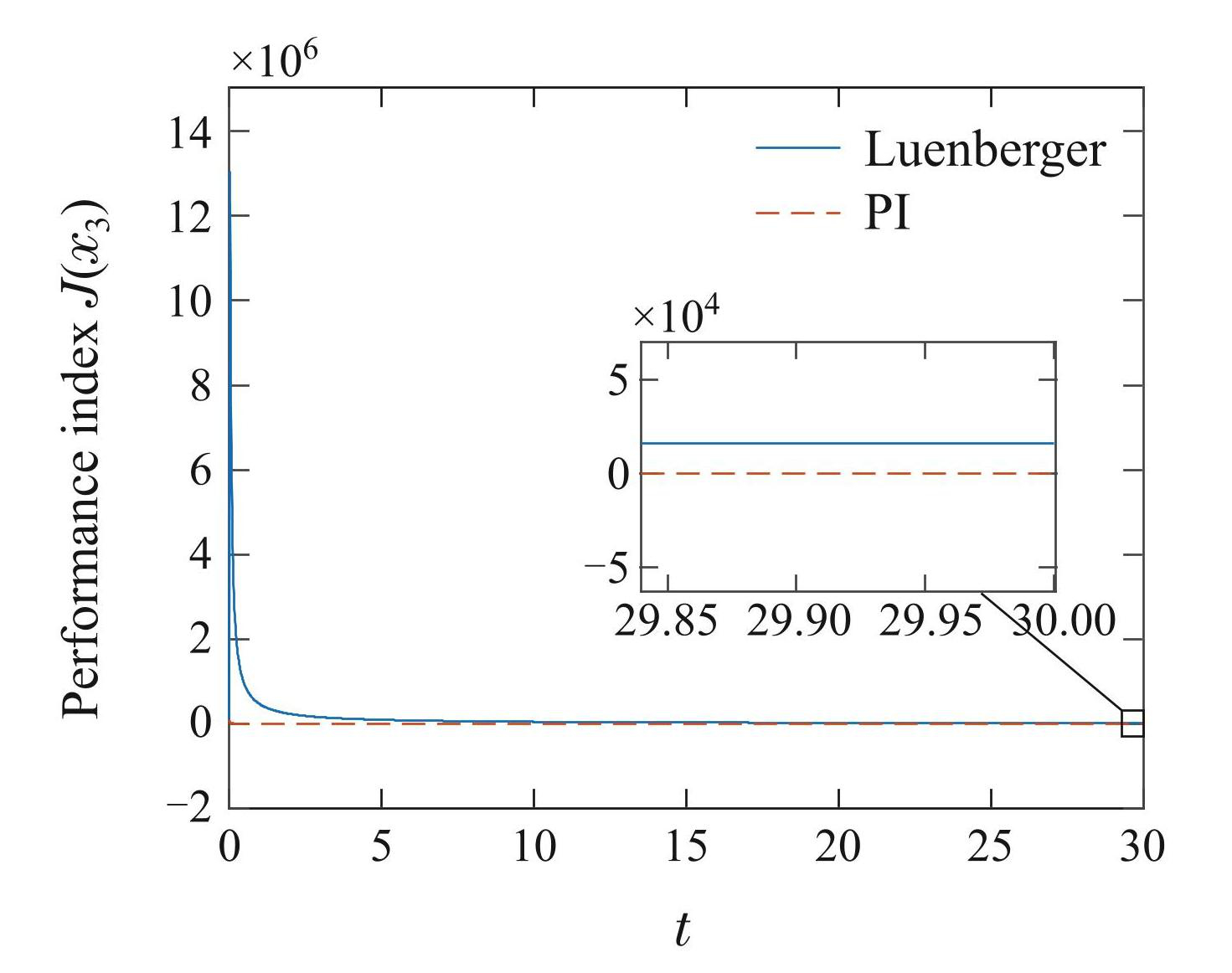
Fig.4Performance index (1)
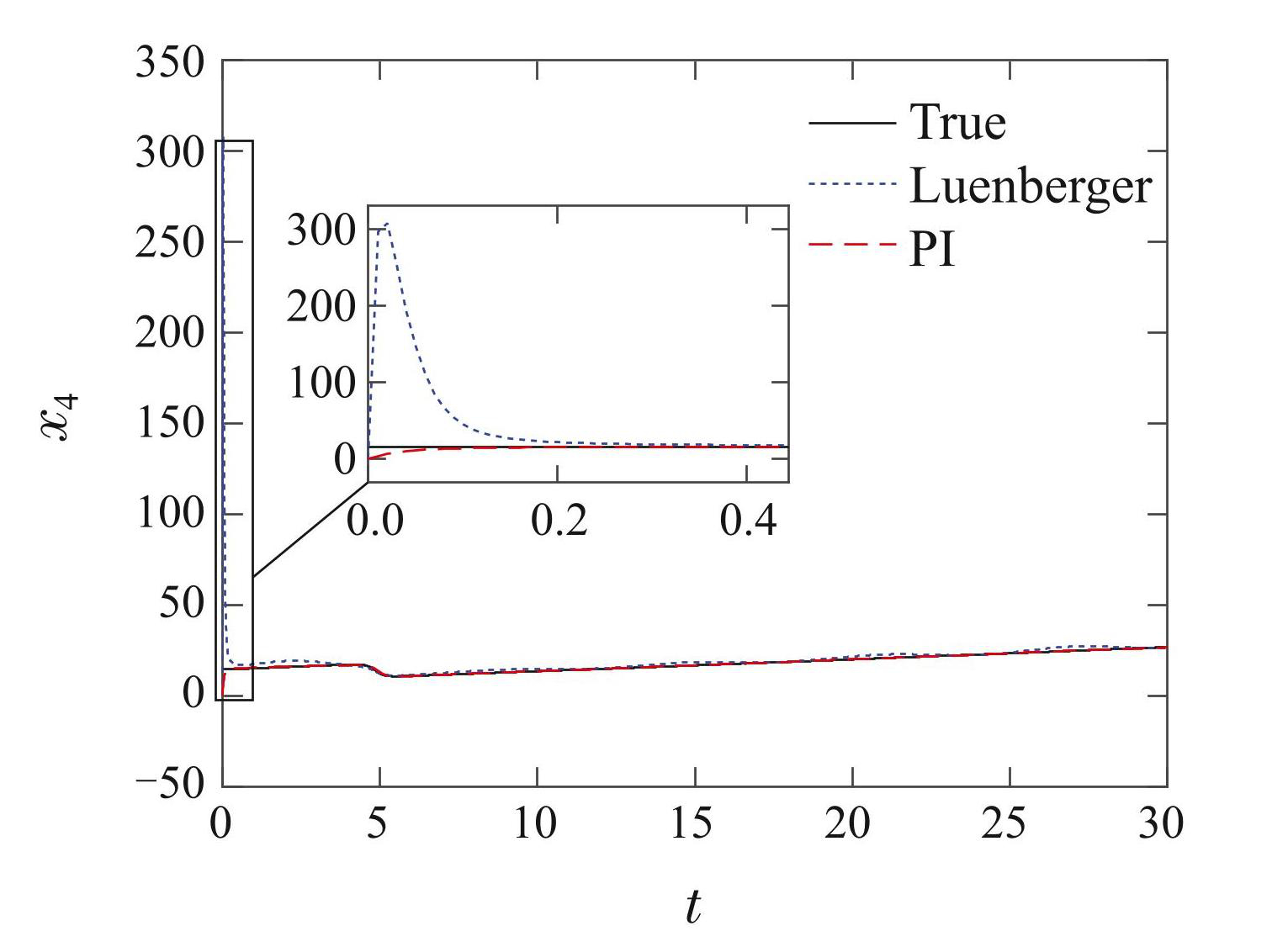
Fig.5State x4 and its estimatesand
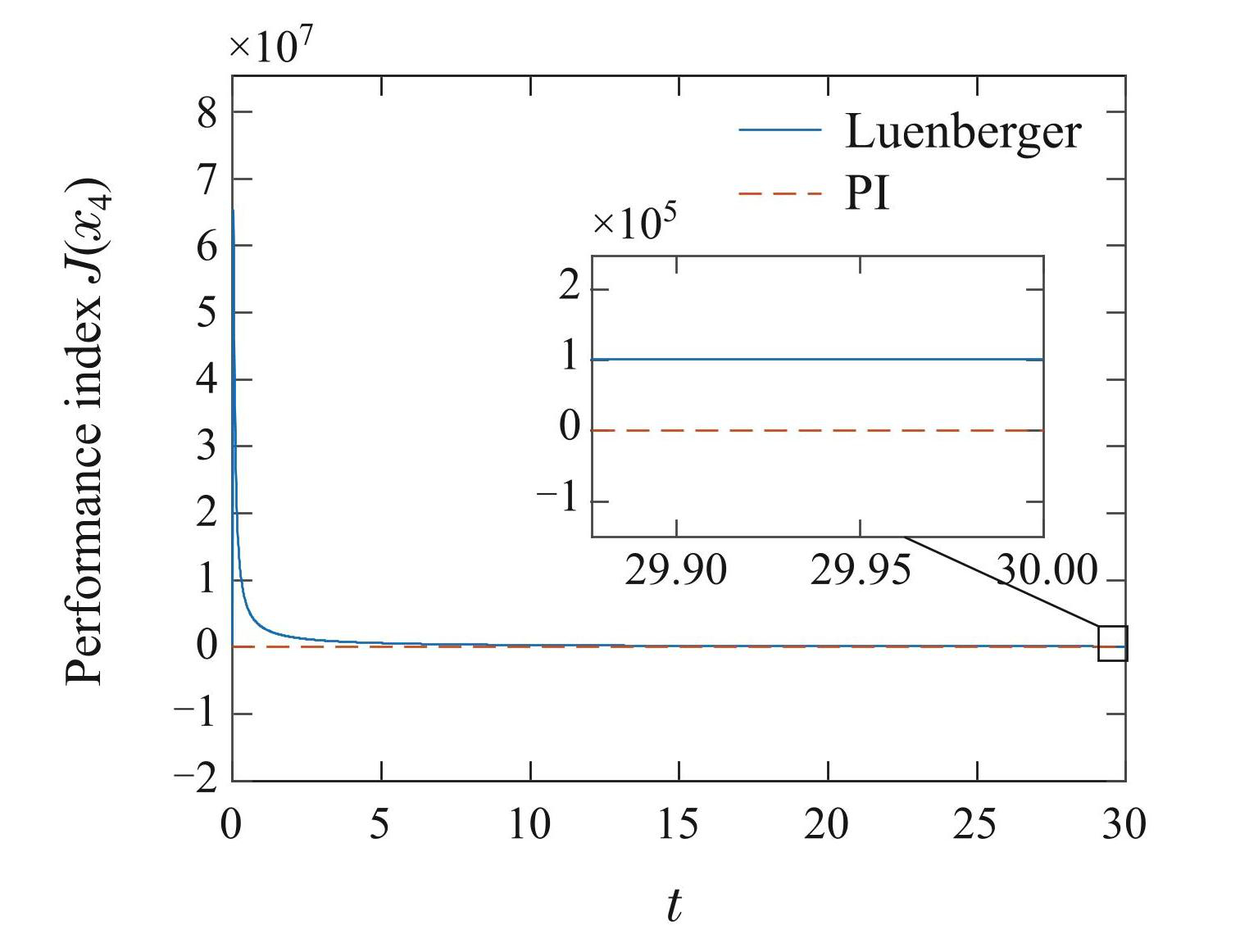
Fig.6Performance index (2)
To illustrate the effectiveness of our output feedback control results, we let
(46)
(47)
and set [k11 k21 k12 k22 k3] = [150 150 50 50 15 8], the initial conditions ϕ1 = k11x1, Ω1 = k21x1, ϕ2 = −k12x2, Ω2 = −k22x2. Then, all conditions of Theorem 2 are satisfied. Now, we refer the reader to Fig.7, where the state of the closed-loop system are depicted and to Fig.8, where the value of corresponding control inputs are plotted. These results serve as further confirmation of the feasibility outlined in Theorem 2.
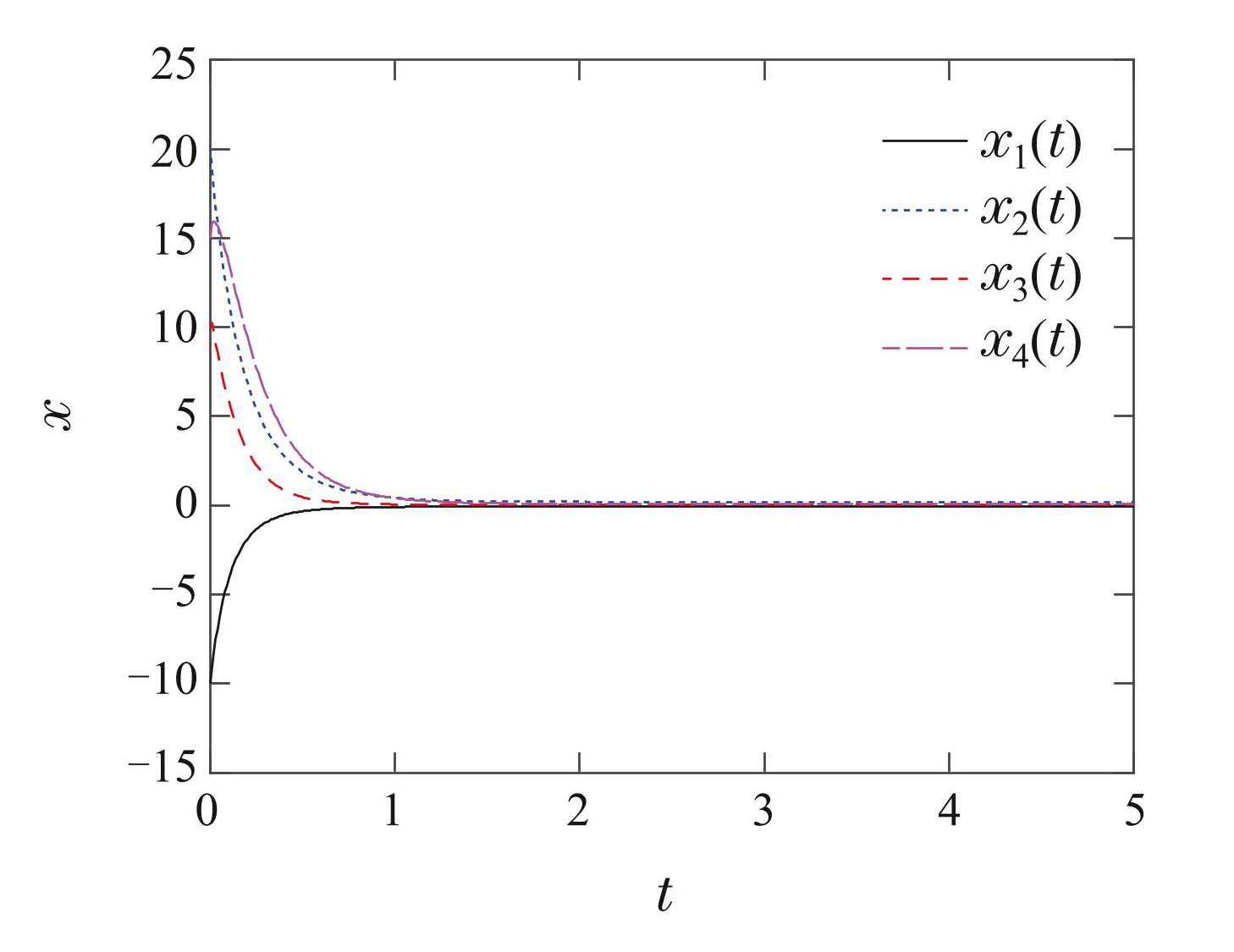
Fig.7The states x1, x2, x3, x4
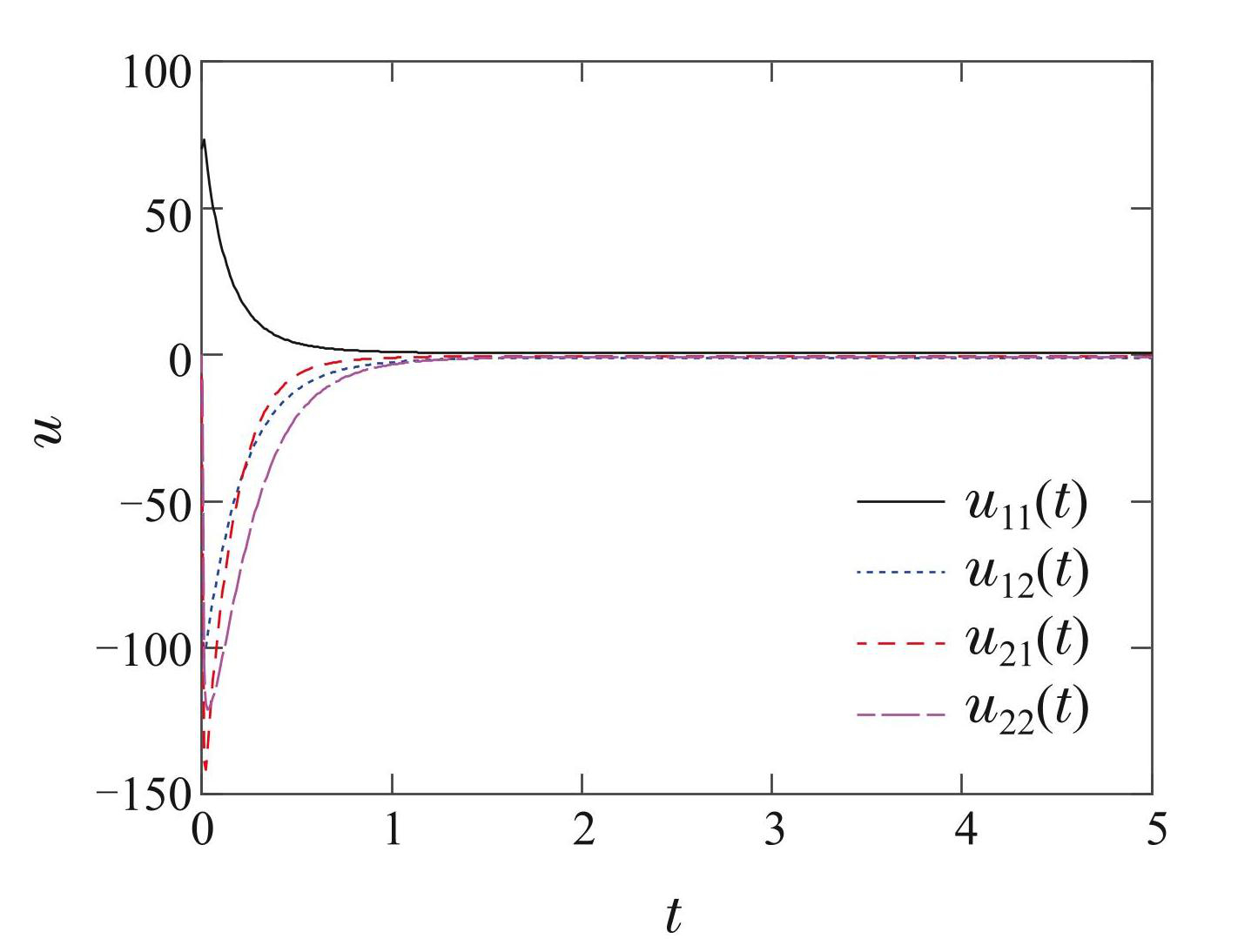
Fig.8Control input u
6 Conclusions
In this paper, we focus on discussing output feedback control problems of the nonlinear fractional-order systems with parametric uncertainties. For this, a novel fractional-order PI observer to estimate the unknown state is first presented. Additionally, we establish a criterion for developing a linear state feedback controller capable of stabilizing a specific class of fractional-order nonlinear systems. To illustrate the effectiveness of our proposed approach, we present a numerical example. Future research could explore the application of the observer and controller to real-world data. For instance, applying this methodology to estimate the unknown states in a known infectious disease model and implementing state feedback to control the spread of the disease would be a valuable extension of this work. Additionally, investigating the robustness and adaptability of the proposed control scheme in more complex or uncertain environments would further enhance its practical relevance.