摘要
在非线性动态系统的模态分析与控制中, 状态变量在某个关键或选定模态中的参与因子是简化稳定性研究的重要工具, 它使得研究能集中于参与度高的少数状态变量. 对于一个线性系统, 其状态变量在某一模态的线性参与因子由左、右特征向量分别定义的模态组成和模态形状共同唯一确定. 然而, 其他类型参与因子的唯一性需要更为深入的研究. 针对非线性参与因子及其他5种参与因子的变体, 本文证明了其唯一性的充分条件. 该条件考虑了模态组成和模态形状中不确定缩放因子的影响. 这些缩放因子源于在分析和控制实际动态系统时选择状态变量的物理单位或数值范围的变化. 因此, 获得和理解参与因子唯一性的充分条件对于在实际场景中正确地将参与因子的概念用于稳定性分析和控制至关重要. 此外, 本文还探讨了状态变量扰动幅度与合理选择缩放因子之间的关系.
Abstract
In the modal analysis and control of nonlinear dynamical systems, participation factors (PFs) of state variables with respect to a critical or selected mode serve as a pivotal tool for simplifying stability studies by focusing on a subset of highly influential state variables. For linear systems, PFs are uniquely determined by the mode’s composition and shape, which are defined by the system’s left and right eigenvectors, respectively. However, the uniqueness of other types of PFs has not been thoroughly addressed in literatures. This paper establishes sufficient conditions for the uniqueness of nonlinear PFs and five other PF variants, taking into account uncertain scaling factors in a mode’s shape and composition. These scaling factors arise from variations in the choice of physical units, which depend on the value ranges of real-world state variables. Understanding these sufficient conditions is essential for the correct application of PFs in practical stability analysis and control design.
Keywords
1 Introduction
In the small-signal analysis of nonlinear dynamical systems, linear participation factors (PFs) of state variables play a crucial role, which are typically computed to assess the involvement of state variables in the linear modes characterized by eigenvalues of the linearized model [1] . A linear PF is defined as the product of the corresponding elements in the right and left eigenvectors associated with an eigenvalue. This definition enables researchers to evaluate both the state variable’s activity within the mode and its contribution to the mode itself, thus establishing a two-way connection between a state variable and a mode [2] .
In comparison, the mode shape and mode composition, which are defined respectively by the right and left eigenvectors of the corresponding eigenvalue, exhibit a one-way linkage and are not uniquely determined due to the inherent scalability of eigenvectors by any non-zero scalar [3] . As a common practice, the right eigenvectors (i.e. mode shapes) are often normalized, with the compositions subsequently determined based on their inverse relationship with the mode shapes [3] . Alterna tively, one may normalize both mode shapes and compositions simultaneously. Importantly, even when mode shapes and compositions may not be unique due to this scaling property, linear PFs remain unique after normalization, owing to the inherent characteristics of linear systems. In the modal analysis and control of linear and nonlinear dynamical systems, the PFs of state variables with respect to a critical or selected mode serve as a pivotal tool for simplifying stability studies by focusing the system monitoring and control on a small subset of highly influential state variables [4] .
Over the past two decades, researchers introduced new types of PFs for stability analysis and control of dynamical systems. The concept of nonlinear PFs was introduced by leveraging the normal form theory in [5-7], which was then applied in designing power system controllers such as power system stabilizers to improve oscillation damping of synchronous generators under small and large disturbances. Efficient computation methods have been proposed for nonlinear PFs such as the tensor contraction-based approach in [8] . Besides nonlinear PFs, [9] introduced the notion of probability PFs, which considers the influence of initial values and evaluates the average contribution of a mode to a state. This work explored two related variants: mode-in-state and state-in-mode probability PFs, which were subsequently examined in detail in [10] . Additionally, [11] and [12] extended the concept of probability PFs to accommodate second-order nonlinearities and aspects of energy, respectively, broadening the scope of applicability. More recently, [13] adopted a formulation similar to the probability PF introduced in [11] and focused on estimating PFs using measurements within the Koopman operator-theoretic framework.
In recent years, the increasing penetration of power electronic inverter-based resources (IBRs) has significantly elevated the risk of power system oscillations, making PFs a valuable tool for stability analysis and control. [14-15] introduced a frequency-domain PF to identify the components with the most significant contributions and to design controllers accordingly. [16] proposed an impedance-based PF to fine-tune black-box models for optimal performance, considering that many inverter-based models remain proprietary due to commercial restrictions. [17] developed a resonance PF using the impedance scanning method to identify the inverter-based resource with the highest contribution. Additionally, [18] introduced the PFs that consider the contribution of a loop rather than a single variable to better understand oscillation paths and contributing components.
The emergence of nonlinear PFs and other new PFs prompts a fundamental question: Do these PFs also retain their uniqueness like the linear PF when subjected to scaling in the shape or composition of a mode?This question is crucial because, to observe and study a real-world nonlinear dynamical system, the measured or estimated values of its state variables depend on the choice of their physical units. When PFs are estimated based on a specific set of physical units, it is expected that their values may be uniquely translated to any other set of larger or smaller physical units through normalization or certain scaling factors. However, it is important to recognize that, unlike linear PFs, the PFs defined for a nonlinear dynamical system, in general, cannot keep their uniqueness after the normalization of their values based on, e.g., the maximum or the sum of PFs [19-20] . This issue can become more significant with the increase of nonlinearity of the system. For instance, in power systems, the increasing IBRs have introduced much more nonlinearities to power system dynamics. Thus, when nonlinear PFs are used to identify the highly participating devices and variables for effective control, the uniqueness of their values independent of the choice of physical units will be critical. This has not been investigated well in literatures.
This paper aims to identify the sufficient conditions under which each type of PF remains unique. It is worth noting that such conditions are nontrivial and require careful analysis, particularly for PF variants – such as nonlinear PFs – especially when normalization is involved in combination with undefined scaling factors. The paper’s primary focus lies in establishing the uniqueness condition for a nonlinear PF, as this approach simplifies the investigation of other PF variants. In the rest of the paper, Section 2 introduces linear and nonlinear PFs, Section 3 discusses the uniqueness of the linear PF against scaling factors on eigenvectors, Section 4 proves a sufficient condition that ensures unique nonlinear PFs of any order, Section 5 extends the proof of uniqueness conditions to other PF variants, and finally, Section 6 draws the conclusion.
2 Linear and nonlinear PFs
Consider a nonlinear dynamical system with a stable equilibrium located at the origin,
(1)
where the state vector, and the vector-fieldis assumed to be analytic. Applying the Taylor expansion at the origin,
(2)
whereis the Jacobian matrix with n distinct eigenvaluescharacterizing its modes andcorresponds to the N-th order terms [21] . Consider two matrices comprising the right (column) and left (row) eigenvectors of A, respectively,
(3a)
(3b)
where ϕi and ψi tell the shape and composition of eigenvalue λi , respectively [22] .
Definition 1 A linear PF for the k-th state in the i-th mode, denoted as pki, is defined as the product of the k-th element in the i-th right eigenvector ϕi and the corresponding element in the left eigenvector ψi of the state matrix A [3, 23]:
(4)
The linear PF can be interpreted as the contribution of the i-th mode to the k-th state [3] or equivalently, the k-th state to the i-th mode [10] for a linear system. As demonstrated later in the paper, such interpretations are generalized and differentiated when defining various variants of PFs for a nonlinear system.
A nonlinear PF can be defined based on normal form theory [24], which nonlinearly transforms the system in (2) around the state vector x into a formally linear system using a new state vector z, by changing the coordinates in the state space [5-6] . Subsequently, modal analysis can be performed on the resulting linear system with respect to the z-coordinates. In practical applications, the normal form method is employed up to a desired order N to eliminate all nonlinear terms of orders 6 N. Consequently, when terms of orders >N are truncated, the resulting N-jet system becomes a linear system with respect to the new coordinates z. While the normal form can be applied to any order, it is most commonly used in 2nd order [7] or 3rd order [21, 25]. Below, a 2nd order nonlinear PF is introduced as an example.
First, let x = Φy and then Eq. (2) becomes
(5)
wheredenotes the coefficients of 2nd order terms after the transformation. Note that the superscript i is not an exponent; rather, it represents the index of the corresponding state variable yi after the transformation [19] . To eliminate2nd order terms in Eq. (5) , a nonlinear coordinate transformation y = h (z) is introduced,
(6)
Assuming there is no resonance in the system (resonance will be discussed later) , meaning that λp +λq − λi ≠ 0 for all p, q, and i, and if each h-coefficient satisfies
(7)
The resulting system in z-space exhibits nonlinearities of only the3rd order or higher. A detailed proof for this transformation can be found in [26] (Chapter 19) , i.e.,
Neglecting its high-order nonlinear terms in z-space, the closed-form solutions in z, and the solutions transformed back to y and x spaces are [27].
(8a)
(8b)
(8c)
In the case of a nonlinear system described in Eq. (2) , a nonlinear PF can be defined to quantify the magnitude of mode oscillation in a state variable when only that particular state variable is perturbed. This concept is a natural extension of the linear PF, and can be found in [7] (pp.4) and [28] (Sec.6) . An explicit expression for the2nd order nonlinear PF is provided below.
Let the initial state x0 has αk at its k-th element and zero elsewhere to represent a perturbation applied to the k-th state,
αk is the perturbation amplitude for the k-th state variable and is commonly assumed to have a value of 1 in many papers [5, 7] . When substituting it into Eq. (6) , the initial state zi0 is typically approximated by [6] :
(9)
Here, the index q starts from p, which is a common practice in the calculation of nonlinear PFs. A detailed discussion concerning this index can be found in [7] (Sec. II-A) . Plugging Eq. (9) into Eq. (8c) , the closedform solution is obtained,
(10)
(11a)
(11b)
(11c)
Eq. (11) provides formulas for two variants of PFs that account for 2nd order nonlinearities. In Eq. (11a) , p2ki is defined as the2nd order nonlinear PF of the k-th state variable in linear mode i, which equals the linear PF pki multiplied by the perturbation amplitude αk, along with an additional correction term . Regarding p2kpq in Eq. (11b) , it represents the nonlinear PF of the k-th state variable in a combination modecharacterized by two linear modes λp + λq [25]. When αk = 1, or equivalently, x0 = ek, the first term in Eq. (11a) becomes identical to the linear PF pk. Some researchers [5] prefer to retain this unit perturbation to preserve this consistency property. This property is also maintained in report [7] and is widely adopted in the literature. In practical systems, considering unit and base values in a per-unit system, it is often more prudent to keep αk as a variable rather than fixing its value1 during formula derivation. This approach facilitates a better understanding of the scaling factor’s impact, as demonstrated by the Example in Section 4.
A first order resonance, often called a strong resonance, occurs when the state matrix has two identical eigenvalues [29]. Eq. (11) remains valid even if the Jordan canonical form is employed for non-diagonalizable A, as described in [7] (Eq.4) , based on a generalization of Poincare’s theorem. In well-designed real-life systems, it’s not common for the eigenvalues to be exactly equal, and therefore, strong resonance is not a common occurrence. However, near resonance can arise when two eigenvalues are very close to each other, and detailed studies can be found in [30] .
A 2nd order resonance occurs when λp+λq −λi = 0, ∃ p, q, i. Additionally, real-life engineering systems, such as power systems, can have zero eigenvalues, which constitute a special type of 2nd order resonance [24] (Theorem 3) . Unfortunately, the definition of the nonlinear PF under resonant conditions is not found in existing literature. Nevertheless, the response of a system with resonance can still be approximated in [31] (Eq. (19) ) , which introduces a third term that grows with time compared to Eq. (8c) . It will become evident later that even when considering resonance or near resonance, the conclusions regarding nonlinear PFs in this paper remain valid based on Eq. (20) . This is because the factor λp +λq −λi or 1 +t does not affect the scaling of eigenvectors. Although this paper only demonstrate the case of 2nd order resonance here, scenarios with higher-order resonance lead to similar conclusions.
3 Uniqueness of the linear PF
This section establishes the uniqueness of a linear PF against scaling uncertainties in mode shape and mode composition by introducing three scaling factors: ξ-factors, σ-factors and θ-factors, which respectively scale mode shapes, mode compositions, and both.
If ϕi is a right eigenvector (mode shape) of λi, it remains so after being scaled by any non-zero scalar [3] (Sec.12.2.2) . Without loss of generality, this paper defines unique mode shapes and mode compositions, each with a unit norm,
(12)
Let and be the i-th right (column) and left (row) eigenvectors, each with a unit norm (e.g., a unity 2-norm) . There exist unique scaling factors σi and ξi ∈ such that, for any left and right eigenvectors Φ and Ψ in Eq. (3) , the following holds:
(13a)
(13b)
(13c)
where δi represents the angle between the mode shape ϕi and mode composition ψi . Throughout the rest of this paper, the sets of σi , ξi and θi (i = 1, · · ·, n) are referred to as ξ-factors, σ-factors and θ-factors, respectively. If θi = 1 for any i, it implies that Ψ = Φ −1 . From Eq. (13c) , as δi is a constant for a particular system, the scaling factors σi and ξi uniquely determine the value of θi .
By introducing the scaling factors, any other mode shape and mode composition matrices can be expressed using and with scaling factors σi and ξi . Without specified notation, the norm in the following discussion refers to the2-norm, as in [3, 6-7]. In fact, extending it to the p-norm does not affect the conclusions in this paper. Additionally, the mode shapes and mode compositions for different modes are orthogonal, resulting in their inner product being equal to zero [3] (Eq. (12.21) ) .
Based on the definitions of linear PF in Eq. (4) and scaling factor in Eq. (13) , it has
(14)
where “◦” denotes the Hadamard product, which represents element-wise multiplication. The i-th column of matrix P contains the linear PFs of all state variables associated with mode i for a given θi . Thus, the following sufficient and necessary condition for unique linear PFs can be derived:
Theorem 1 Providing a scaling factor θi ∈ defined in Eq. (13) , with i ∈ {1, 2, · · ·, n}, the linear PFs of all state variables associated with mode i, denoted as pki for k ∈ {1, 2, · · ·, n}, are unique if and only if the corresponding θi is unique.
Theorem 1 indicates that the linear PFs associated with mode i are unique if and only if θi is determined. This theorem highlights a crucial property of linear PFs: the linear PF for each state variable remains constant regardless of changes in σi or ξi once their product θi is fixed. Consequently, the vector of linear PFs for all state variables within mode i are unique after normalization.
4 Uniqueness of nonlinear PFs
This section will establish a sufficient condition for the uniqueness of a nonlinear PF of any nonlinearity order with a linear or combination mode in the presenceof scaling uncertainties in eigenvectors.
To obtain a theorem covering any order of nonlinearities for both linear and combination modes, it is essential to clarify the orders of a nonlinear PF and a mode. In the following content, is used to represent the nonlinearity order, corresponding to the order of the highest nonlinearity considered in the Taylor series. Additionally, is employed to denote the combination order of the combination mode, where M = 1 signifies a linear mode. For instance, in a 2nd order nonlinear PF, as depicted in Eq. (11) , N is fixed at 2 to truncate terms with nonlinearities of orders greater than 2, while M = 1 for Eq. (11a) and M = 2 for Eq. (11b) . It is worth noting that, due to the utilization of the normal form method, M is constrained by the order of the Taylor series, resulting in M ≤ N.
The Taylor expansion of (1) up to an infinite order is represented as follows:
(15)
where xk denotes the k-th state variable, aki represents the element in the k-th row and i-th column of state matrix A, ak, pq is the p-th row and q-th column element in the k-th Hessian matrix, ak, r···v is the coefficient of the N-th order Taylor series term. Similar to Eq. (8c) , a closed-form expression in x-space up to an infinity order is given by [31],
(16a)
(16b)
(16c)
Each h-coefficient has an approximate formula in Eq. (16c) if the N-th order nonlinearity is significantly more dominant than any lower-order nonlinearities. Let N = 2. Then Eq. (16) is downgraded to the 2nd-order normal form where Eq. (16a) corresponds to Eq. (8c) , Eq. (16b) is identical to Eq. (8a) , and Eq. (16c) becomes Eq. (7) .
Since the normal form expression for any order has been derived in Eq. (16) , the corresponding nonlinear PF will be derived in this part. This paper continues following the definition of nonlinear PF in Eq. (11) and retain the perturbation amplitude αk. Notice that theindex r starts from 1 while the index v starts from the index w, just as q starts from p in Eq. (9) . For simplicity, this initial value expression can be rewritten as
(17)
Thus, the nonlinear PF with a linear mode is
(18a)
and the nonlinear PF for an M-th (M ≤ N) order combination mode involving M modes with indices r, s, · · ·, u is
(18b)
If is set to 1 for i = 1, the nonlinear PF in Eq. (18a) can be regarded as a particular case of Eq. (18b) with a combination mode order when M = 1. Note that Eq. (16a) contains an infinite number of terms, allowing Eq. (18) to define a nonlinear PF considering nonlinearities of any order. In practice, calculating a nonlinear PF is typically performed up to a desired order N, with all terms of orders greater than N truncated. For instance, when N = 2, Eq. (18) yields the same 2nd order PF as defined in (11) , while a3rd order PF is provided in [21] .
There is the following theorem on the uniqueness of nonlinear PFs up to the N-th order.
Theorem 2 For a scaling factor defined in Eq. (13) , i ∈ {1, 2, · · ·, n}, the nonlinear PFs represented by pk, rs···u with k ∈ {1, 2, · · ·, n}, for all state variables associated with a single linear or combination mode constructed by M modes r, s, · · ·, u, are unique if all θ-factors are unique.
Proof In the following proof, any variable with a hat ( ˆ) signifies its irrelevance from the scaling factors ξi, σi or θi . According to Eq. (13) , the mode shape and composition with respect to mode i are as follows:
(19)
For an M-th order combination mode (or a linear mode for M = 1) , substitute Eq. (19) into Eq. (18b) , and the nonlinear PF becomes
(20a)
(20b)
∀l ∈ {r, s, · · ·, u}. Note that, in Eq. (20b) ,
(20c)
By substituting Eq. (20c) into Eq. (20b) , all σ-factors and ξ-factors can be replaced by their products θ-factors except for ξl, as demonstrated below. Similarly, as in the case of Eq. (20c) , the coefficient in Eq. (20a) can be written as
Therefore, substituting it into Eq. (20a) enables the elimination of all scaling factors σi and ξi . Consequently, Eq. (20) simplifies to
(21a)
(21b)
Notably, the nonlinear PF is independent of both σ-factors or ξ-factors; rather, it relies on the determination of every θi, i ∈ {1, 2, · · ·, n}, or in other words, the values of all θ-factors. Theorem 2 establishes that the uniqueness of nonlinear PFs depends on the determination of all θ-factors. This differs from the case of linear PFs in Theorem 1, where only the corresponding θi is necessary for uniqueness. Unlike Theorem 1 for linear PFs, the condition in Theorem 2 is sufficient but not necessary. This implies that a unique set of pk, rs···u (k = 1, 2, · · ·, n) might correspond to multiple sets of θ-factors. In fact, all possible θ-factors that yield a unique set of nonlinear PFs can be determined by solving n equations in this form,
(22)
The number of roots of these equations corresponds to their Bezout number, denoted as ∏ di for all i [32] (Th.1) , where di represents the degree of gi, which is also the order of the nonlinear PF. It is evident that as the order of nonlinear PFs increases, the solutions for θ-factors will be non-unique. It is important to note that the Bezout number accounts for complex roots. The precise count of all real roots can be determined by solving Eq. (22) [33], which is known to be an NP-complete problem [34] . In fact, selecting one set of θ-factors by Theorem 2 is sufficient to ensure the uniqueness ofthe calculated PFs, while finding all possible sets of θ-factors is rarely needed in practical applications and is not the focus of this paper.
The influence of the scaling factors θi is similar (though not equivalent) to adjusting the perturbation amplitude. Eq. (21b) can be expressed as:
Therefore, modifying the perturbation amplitude αk and carefully designing θi may either cancel each other out or produce the same effect on nonlinear PFs. Moreover, selecting different scaling factors θi allows for the amplification or reduction of the contribution of a specific mode i. Unfortunately, the issue of determining a reasonable perturbation amplitude αk remains unsolved, and it is typically based on empirical knowledge [6] or set to a unit value for simplification [2]. In contrast to the perturbation amplitude αk, the scaling factor θi offers an additional dimension for adjusting nonlinear PFs. The participation factors describe how state variables and modes are related, showing a certain degree of symmetry between them. Since the perturbation amplitude is defined from the state-variable perspective, an analogous index from the modal perspective is introduced. Fig.1 illustrates this concept.

Fig.1The relationship between perturbation amplitudes and scaling factors
Considering that the perturbation amplitude is chosen with respect to state variables, it is logical to introduce another factor that accounts for modes, which is the scaling factor in our analysis. Mathematically, there is no inherent reason to believe that some variables are more important than others, hence the common practice of setting αk = α for all k. Therefore, this paper proposes θi = θ.
Example 1 Consider a nonlinear system,
Following the normalization process, this paper focuses on the same linear mode λ1 = −0.50 + 4.97j. This paper considers three cases: I) σi = 1 and ξi = 1; II) σi = 1 and θi = 1; III) ξi = 1 and θi = 1. Notably, in Case I, the PFs differ from those in Cases II and III due to variations in the θ-factors,
The examination focuses on the system’s responses under varying perturbation amplitudes to clarify the observed differences. In Cases II or III (where the results are the same) , the scaling factor θi remains consistent across all four modes (λ1 to λ4) . Consequently, following the definition, the perturbation amplitude is set as = 1 to illustrate the nonlinear PF. However, in Case I, the scaling factor θi varies among the four modes, rendering it impractical to represent them under a single type of disturbance. Consequently, the nonlinear PFs in Case I closely resemble the linear PFs, whereas the outcomes in Cases II and III exhibit more significant differences. The responses of λ1 mode are reconstructed based on Eq. (20) . It’s crucial to clarify that θi are distinct from the perturbation amplitudes αi, and these responses are utilized solely to illustrate the influence of θi , which is similar to adjusting the perturbation amplitude αi . In practical scenarios, mode shapes of a monitored nonlinear system can be obtained through signal processing techniques, such as Prony analysis [35], which measures system responses under small disturbances to approximate linear system behavior. However, obtaining a complete mode shape matrix Φ can be challenging due to limitations in measuring devices. When calculating PFs, mode compositions cannot be directly derived from Φ−1 and must be obtained from the system model [36-37], where the choice of scaling factors for modes can have a significant impact. Related results are illustrated in Fig.2 and 3.
5 Uniqueness of other PFs
Based on Theorems 1 and 2, this section proves the uniqueness conditions for other PFs, as detailed in Table1.


Fig.2The responses with different perturbation amplitudes

Fig.3The reconstructed responses for mode λ1 in Case I and Case II or III
Table1The variants of participation factors
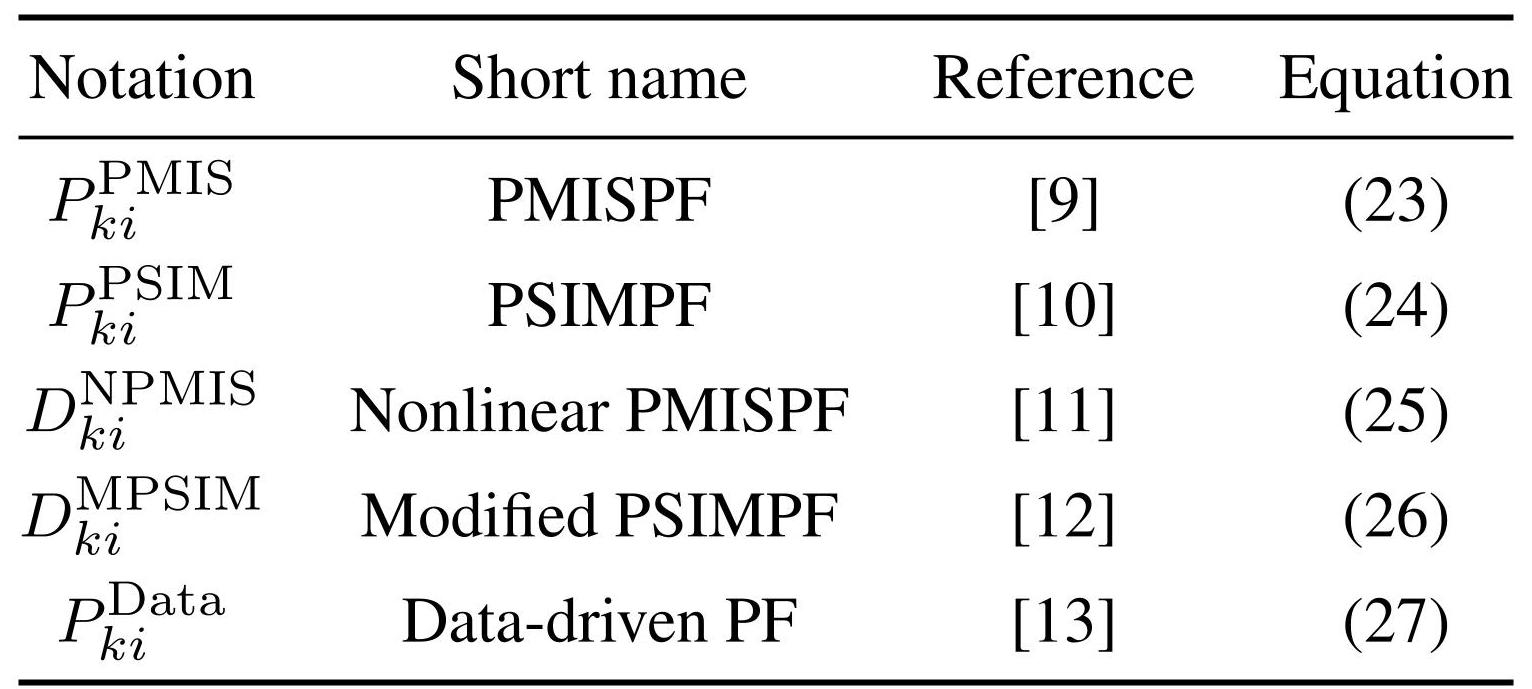
Corollary 1 The PMISPF [9] is unique if and only if the corresponding θi is unique.
The linear PF is independent of the selection of initial values. The PMISPF considers the quantity of the initial condition by computing a mode’s average contribution to a state [9] . Following a similar proof structure as in Theorem 1, Eq. (13) is applied to replace the ϕi and ψi with i and i, so it has
(23)
where E{·} represents the expectation operator, and xk0 denotes the initial value for the k-th state variable in x-space. It is obvious that in Eq. (23) is unique if and only if the corresponding θi is unique. While distinguishing between state-in-mode and mode-in-state is unnecessary for a linear PF due to their identical nature, a study by [10] highlights that PSIMPF and PMISPF are not interchangeable. In this paper, another differencebetween them is exposed in the view of uniqueness,
(24)
where zi0 = ξiJi (θ1, θ2, · · ·, θn) denotes the initial value for the i-th state variable in z-space, Ji : is a function of all θ-factors, and ∗ in the superscript shows its conjugate value (not conjugate function) . Thus, the uniqueness of PSIMPF is related to all θ-factors rather than only θi in PMISPF. The nonlinear PMISPF extends the concept of probability MISPF introduced in Eq. (23) by incorporating2nd nonlinearity through normal form theory [11]. For simplification, αk = 1 is assumed in the following proof related to nonlinear PF. Based on Theorem 2, it is intuitive that it is unique if all θ-factors are determined,
(25)
The modified PSIMPF extends its consideration to include the energy of the mode [12] . Similar to Eq. (24) , it is shown in Eq. (26) that all the θ-factors appear in :
(26)
In the data-driven PF estimation approach described in [13], the PFs are determined using Koopman mode decomposition. Notably, Koopman modes are defined from a signal perspective, which may result in their mode shapes and composition coinciding with those defined in the system model. The definition of Koopman modes bears a resemblance to the structure of the PMISPF outlined in Eq. (23) , unless a Koopman mode is specifically under consideration:
(27)
where γ0 ∈ and γk0 are the initial values for the observable vector and k-th element. ui and vi are the i-th left and right eigenvector of the Koopman operator with
where B ∈ is the matrix determined by the observed function and state variable. Note that Eq. (27) is similar to Eq. (23) . Hence, if the scaling factors and are introduced for Koopman mode by replacing ϕi and ψi with ui and vi in Eq. (13) . From Eq. (23) and Eq. (27) , it is easily known that is unique if and only if the corresponding for Koopman mode i is unique.
6 Conclusion
This paper investigates the uniqueness conditions for various types of PFs under scaling uncertainties in mode shapes and compositions. A sufficient condition for the uniqueness of nonlinear PFs is established by considering three scaling factors. The uniqueness conditions for several other PF variants are also discussed. Understanding these sufficient conditions is essential for the correct application of PFs in practical stability analysis and control of nonlinear dynamical systems.