摘要
针对执行空间重复任务的非参数不确定旋转电机系统, 本文提出一种空间自适应全限幅重复学习控制方法. 通过引入空间微分算子变换, 将受控系统从时间域形式转换为空间域形式. 利用旋转电机的空间周期重复运行特性, 设计空间自适应全限幅重复学习控制器, 实现旋转电机角速度对期望轨迹的高精度跟踪. 构造空间全限幅重复学习律、估计和补偿具有空间周期特性的非参数不确定动态, 并保证估计值被限制在指定界内. 最后, 通过李雅普诺夫理论分析误差的收敛性能, 并给出实验结果验证所提方法的有效性.
Abstract
A spatial adaptive fully-saturated repetitive learning control method is proposed for rotating motor systems that perform spatial repetitive tasks. The spatial differential operator is introduced to transform the controlled system from the time domain to the spatial domain. By utilizing the spatial periodic repetitive operation characteristics of rotating motor systems, a spatial adaptive fully-saturated repetitive learning controller is designed to achieve high-precision tracking of desired trajectory for the angular velocity of rotating motor. The fully-saturated repetitive learning law is constructed to estimate and compensate for system non-parametric uncertainties with spatial periodic characteristics, and the estimated value can be limited within the specified bounds. Finally, the error convergence is analyzed through the Lyapunov stability theory, and simulation results are provided to verify the effectiveness of the proposed method.
1 引言
旋转电机是一种将电能转换为机械能的装置,在硬盘驱动系统、工业机器人、激光打印机等伺服系统中应用广泛 [1-5] . 在旋转电机控制器设计过程中,电机跟踪精度是关键的性能指标之一,而提高旋转电机跟踪精度的一个重要途径是充分利用其周期运动特性. 旋转电机的周期运动特性主要体现为关于角位置的空间周期特征,即电机转子旋转整数个循环后总会回到相同的角位置.
经典的重复学习控制通常也被称为重复控制,该方法通过在频域内应用内模原理构造周期为T的任意周期信号内模,实现对周期信号的完全跟踪 [6-8] . 近年来,基于李雅普诺夫方法的重复学习控制被提出,该方法能够利用上一周期运行的数据修正当前周期的控制输入,实现对周期轨迹的零误差跟踪或周期不确定动态的完全抑制,因此被广泛用于处理不确定系统的高精度轨迹跟踪问题 [9-12] . 文献 [13] 针对一类满足 Lipschitz条件的非参数不确定非线性系统的周期性轨迹跟踪问题,提出一种重复学习控制方法,但重复学习律的设计中并未考虑对估计值进行限幅. 目前,现有的重复控制方法大多基于时间域设计,无法充分利用旋转电机所呈现的空间周期重复特性.
文献 [14] 提出空间域的概念,并设计了一种空间重复控制方法消除等速旋转系统中与位置相关的周期性扰动. 空间重复控制方法为与位置相关的周期性信号构建了精确的内部模型,保证了稳定状态下的高精度控制性能. 文献 [15] 提出一种基于时滞算子的空间重复控制方法,通过实时优化硬件和软件中断的问题,保证了在空间域和时间域同步控制. 文献 [16] 针对一类在有限空间区间内重复运行的二阶不确定运动系统,提出一种空间迭代学习控制方法,利用空间算子将时间域上的系统不确定动态转换到空间域,并通过设计半饱和学习律保证估计值的有界性. 在此基础上,文献 [17] 将空间迭代学习控制方法拓展至一般形式的运动系统,并在城市轨道交通上进行了仿真验证. 文献 [16] 和文献 [17] 主要针对有限空间区间的空间迭代学习,而针对无限空间的工作相对较少. 文献 [18] 基于内模原理、空间低通滤波器和频率对准,提出一种针对旋转系统的无限空间重复控制方法,从而衰减空间域内的周期性扰动. 内模原理的基本思想是将包含参考信号动态结构的信号发生器嵌入闭环系统,在基频下有可能会产生较高的控制增益.
基于以上讨论,本文针对非参数不确定旋转电机系统,提出一种基于李雅普诺夫方法的空间自适应重复学习控制方法. 本文主要贡献在于: 1)现有的空间迭代学习控制方法主要解决有限空间区间的轨迹跟踪问题 [16-17],而本文则针对在无限空间区间运行的旋转电机系统,根据其空间周期重复运行特性,提出空间自适应重复学习控制方法,实现旋转电机角速度对期望轨迹的高精度跟踪; 2)不同于基于内模原理的重复控制方法 [18],本文基于李雅普诺夫稳定性定理设计全限幅空间重复学习律,精确估计和补偿具有空间周期特性的非参数不确定动态,并保证估计值被限制在指定界内.
2 问题描述
旋转电机在旋转坐标系下的数学模型表示为 [11]
(1)
其中: J为转动惯量,B为粘滞摩擦系数,np为电机极对数,iq为q轴定子电流,TL(θ)表示与位置有关的负载转矩,θ和ω分别为旋转电机的转子角位置和角速度. 为了方便后续控制器设计,记u(t)= iq,则式(1)可写为
(2)
其中:均为未知常量; α(θ)=表示与转子角位置 θ 相关的周期不确定动态,且空间周期S 已知,即α(θ)= α(θ − S). 为了便于阐述空间重复学习控制算法,首先给出如下定义和假设.
定义 1 旋转电机转子角位置θ,可表示为
(3)
其中φ(t)表示关于时间t的函数.
假设 1 旋转电机的角速度在整个运行过程中始终朝着一个方向旋转,且角速度满足如下条件:
(4)
注 1 假设1保证φ(t)是关于时间t的单调递增函数,即存在逆映射t = φ −1 (θ). 实际中,许多旋转运动系统可以满足此假设,比如风力涡轮机、磁阻电机转矩控制、激光打印机中的无刷直流电机、绕轨道旋转的卫星等 [16-19],在启动之后总是朝着一个方向转动,且速度均保持大于0.
假设 2 存在已知常数,使得空间周期不确定动态满足; 系统不确定参数h,β有界,分别满足h∈[hm,hM],β ∈[βm,βM],其中hm,hM,βm,βM 为未知常数.
定义 2 定义旋转电机在空间域的变量,即
(5)
(6)
其中:表示在空间域中以转子角位置θ为自变量的角速度,表示在空间域中以转子角位置θ为自变量的控制输入. 为了控制器设计过程的简明表达,在不产生变量混淆的情况下省略自变量θ.
定义 3 定义关于转子角位置的微分算子
(7)
基于以上假设和定义,利用微分算子(7)可将系统(2)从时间域转换到空间域
(8)
本文的控制目标是针对系统(8)设计空间自适应全限幅重复学习控制器,使得旋转电机角速度能够精确跟踪给定的期望角速度.
3 空间自适应重复学习控制设计
定义旋转电机转子的角速度跟踪误差
(9)
其中表示给定的期望角速度轨迹.
构造关于位置θ的Lyapunov函数
(10)
对在空间域求导可得
(11)
根据式(11),在空间域设计自适应重复学习控制器,表达式为
(12)
其中: k是正的增益系数; 分别表示α(θ),β,h的估计值.
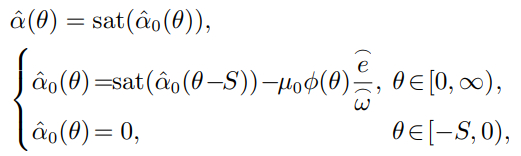
考虑 α 在空间域上存在着固定周期 S = 2π,即 α(θ)= α(θ − S),设计如下全限幅重复学习律估计 α(θ):
(13)
其中: µ0 >0是学习增益; sat(·)为饱和函数,对任一标量a有
(14)
其中为a 的限幅值. 式(13)中,ϕ(θ)的作用是保证在θ = iS(i = 1,2,3,· · ·)处的连续性.
此外,式(12)中的自适应更新律设计为
(15)
其中µ1,µ2为正常数. 然而,在实际情况中,式(15)所示自适应更新律可能存在误差的正向累加,导致估计值发散. 为此,在自适应更新律设计中,引入非连续投影映射,可以将参数估计值限制在预设的区间内 [20],其具体表达式为
(16)
其中projb(·)为非连续投影算子,定义为
(17)
其中: b为待估计参数,满足为b的估计值. 投影算子projb(·)具有如下性质:
(18)
注 2 由假设1可知因此控制器(12)和全限幅重复学习律(13)不会出现奇异问题.
注 3 为保证估计值的有界性,文献 [16] 采用部分限幅学习律,即然而,由于未对项进行限幅,难以被限制在指定界内. 本文设计的全限幅学习律(13)对和分别进行限幅,因此能够保证被有效限制在指定界内.
注 4 ϕ (θ)是定义在θ ∈ [0,+∞)上的连续函数,满足 ϕ(0)= 0和ϕ(θ)≡ 1,∀θ ∈ [S,+∞),并在区间θ ∈ [0,S)上严格递增. 不失一般性,ϕ(θ)可选择为
(19)
4 收敛性分析
引理 1 给定标量a,b,假设其中为b的限幅值,有如下不等式成立:
(20)
定理 1 针对旋转电机系统,在空间域设计重复学习控制器(12)、全限幅重复学习律(13)以及自适应更新律(16),则系统跟踪误差收敛至原点附近邻域内.
证构造如下类Lyapunov函数:
(21)
其中:
(22)
其中:分别表示α(θ),h,β的估计误差,即
(23)
将式(12)代入式(11)可得
(24)
对和在空间域,求导可得
(25)
将式(24)–(25)代入式(21),得到
(26)
考虑α(θ)的空间周期性,即α(θ)= α(θ − S),式(26)可以写成
(27)
根据几何性质a2 − b2 =(a + b)(a − b),式(27)可以写成
(28)
根据式则由式(28)可得
(29)
由式(13)可得,代入式(29),得到
(30)
根据引理1,有不等式成立,从而式(30)可写为
(31)
把式(24)代入式(31)可得
(32)
将自适应更新律(16)代入式(32)可得
(33)
由投影算子性质(18),可将式(33)写为
(34)
定义k = k1 + k2,代入式(34),得到
(35)
根据ϕ(θ)的定义(19),本文分别在θ∈[0,S)和θ∈ [S,+∞)两个区间上分析.
当θ∈[0,S)时,有(1−ϕ) 2∈(0,1],故有
且
(36)
其中是α(θ)的上界. 式(35)可以放缩为
(37)
由式(37)可知,当时,有
当θ ∈ [S,+∞)时,1 − ϕ ≡ 0,则式(35)可以写成
(38)
由式(37)–(38)可得,系统跟踪误差收敛至原点附近邻域内.
5 实验分析
为验证本文所提控制方法的有效性,本节给出基于旋转电机模型(1)的实验结果. 实验中旋转电机的参数设置如表1所示 [11] . 实验装置如图1所示,转子的参考角速度为=(50 + 20 sin θ)rad/s,电机的额定负载为 1.8 N·m,额定电压为 250 VAC,额定功率为 570 W,用于驱动永磁同步电机的三相逆变器是智能功率模块(intelligent power module,IPM)PS21A79. 控制板上的主控芯片是德州仪器公司的 TMS320F2833 5,与1台具有CCS12.0编程环境的PC机相连. 转子位置由增量编码器(分辨率: 5000 pulse/r)测量,相电流由TMS320F28335ADC模块测量,300 V直流母线电压由直流电源KPS3005D产生. 实验数据通过串行通信发送到PC机,并通过MATLAB对实验数据进行分析处理.
表1旋转电机系统模型参数
Table1The parameters of the rotating motor system model
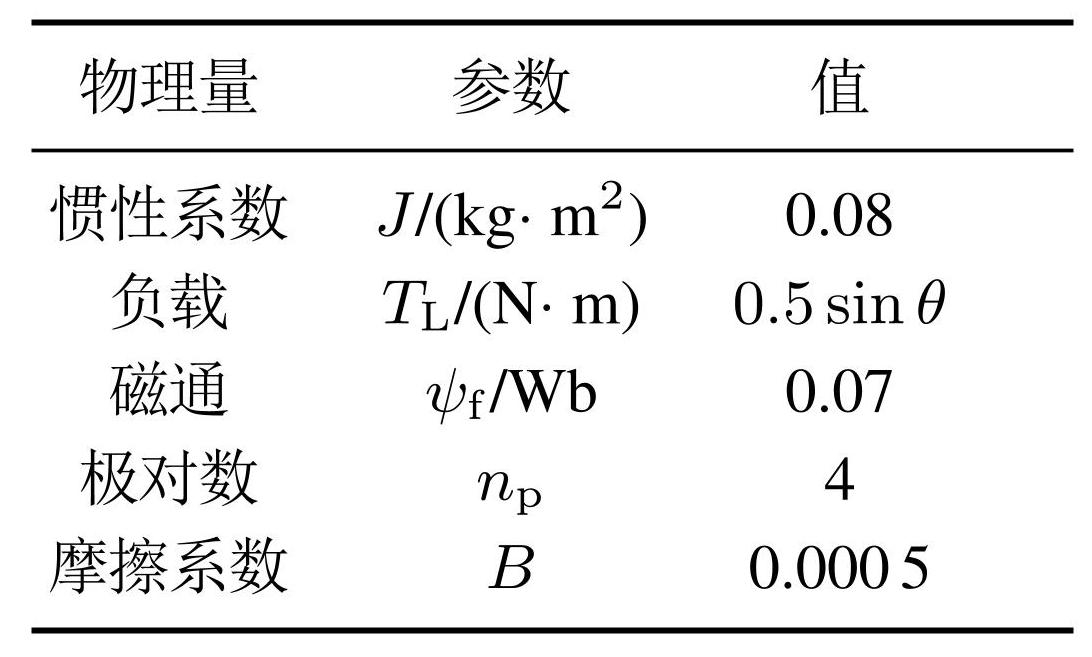

图1实验装置图
Fig.1The experimental setup
M1方法为本文提出的空间自适应重复学习控制方法,其中控制器、全限幅重复学习律以及自适应更新律的表达形式如式(12)–(13)(16)所示. 控制参数设置为k= 0.1,µ0 = 20,µ1 = 0.1,µ2 = 0.01. M2方法为常用的PID控制方法,其控制器表达形式为
(39)
跟踪误差及其微分和积分误差分别定义为
(40)
通过经验凑试法,将PID控制器参数设定为参数设定为kp = 0.2,ki = 0.1,kd = 0.1.
实验结果如图2–6所示. 其中: 图2和图3分别是 M1和M2方法的角速度跟踪效果和角速度跟踪误差对比,通过M1和M2的对比可以看出,M1方法能够有效消除周期误差,而M2方法的跟踪误差仍然具有一定的周期性. 图4是M1方法下不确定动态α(θ)的估计结果,图5则描述未知参数h和β的估计. 由图4和图5可以看出,M1方法能够有效估计并补偿系统的不确定性. 图6给出了两种方法的控制输入. 实验结果表明,本文所提出的M1方法能够有效估计并补偿系统中的不确定性和消除周期误差,实现对周期期望轨迹的精确跟踪.

图2角速度跟踪性能对比
Fig.2Comparison of angular velocity tracking performance

图3跟踪误差对比
Fig.3Comparison of tracking errors
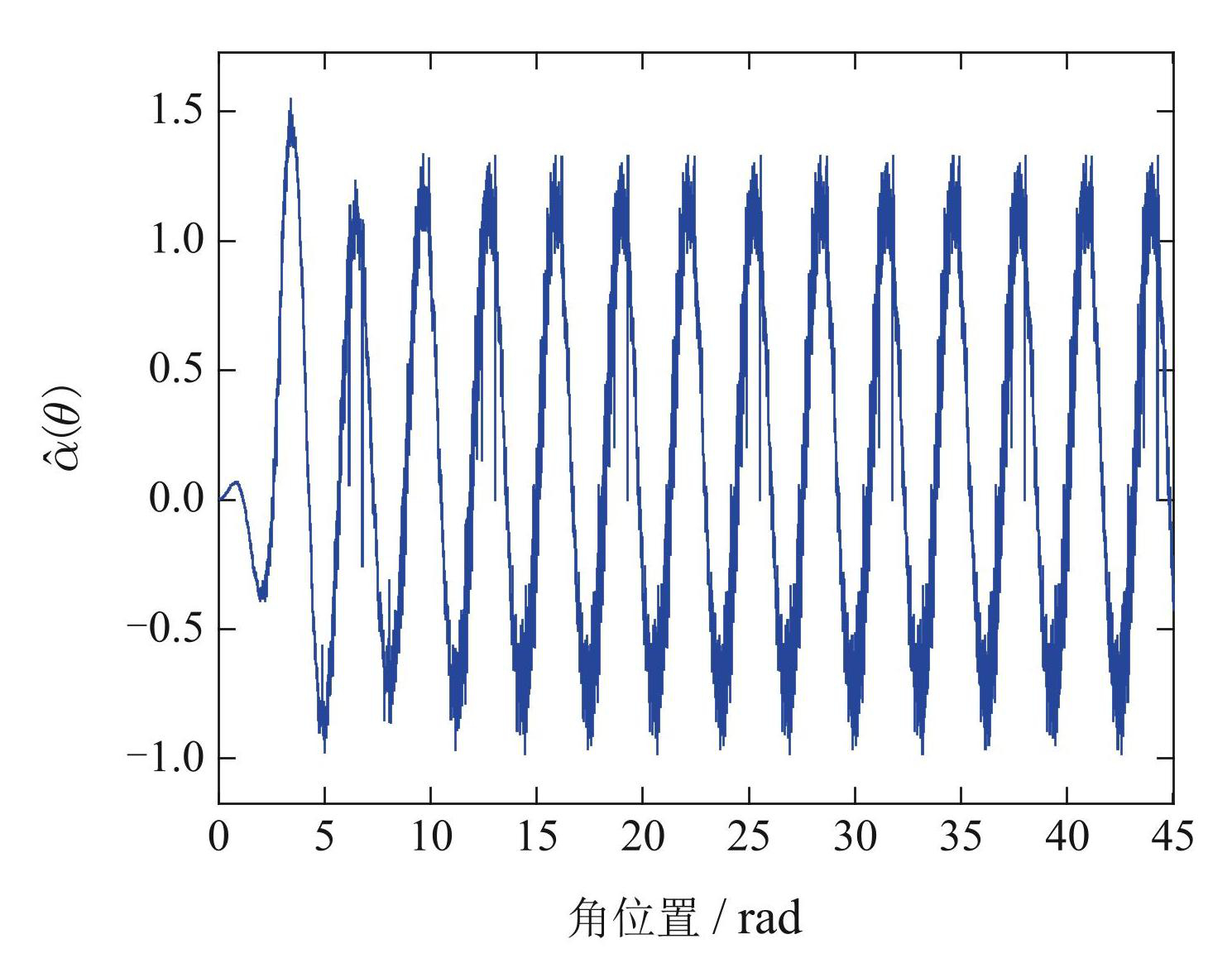
图4不确定动态α(θ)的估计
Fig.4Estimation of uncertain dynamic α (θ)
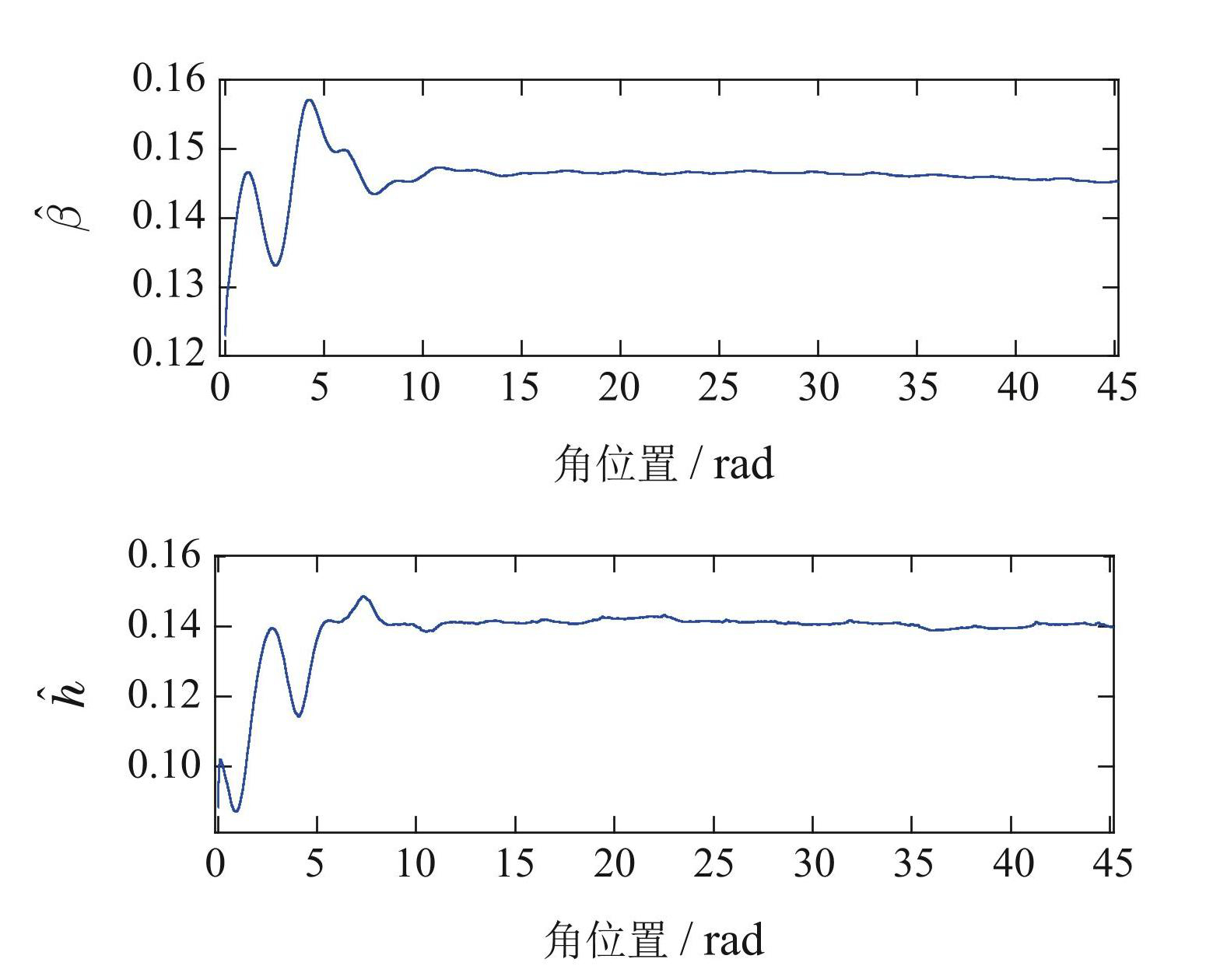
图5未知参数h和β的估计
Fig.5The estimation of the unknown parameters h and β
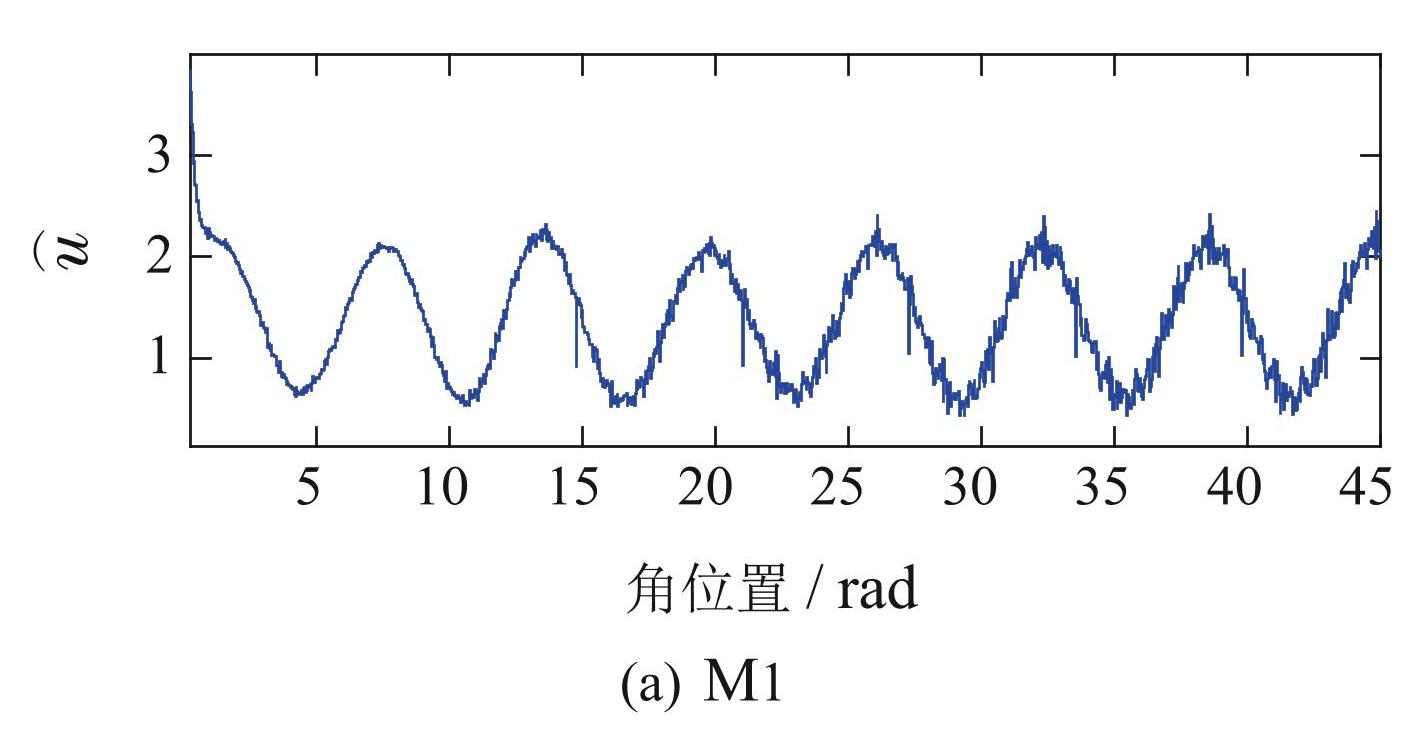
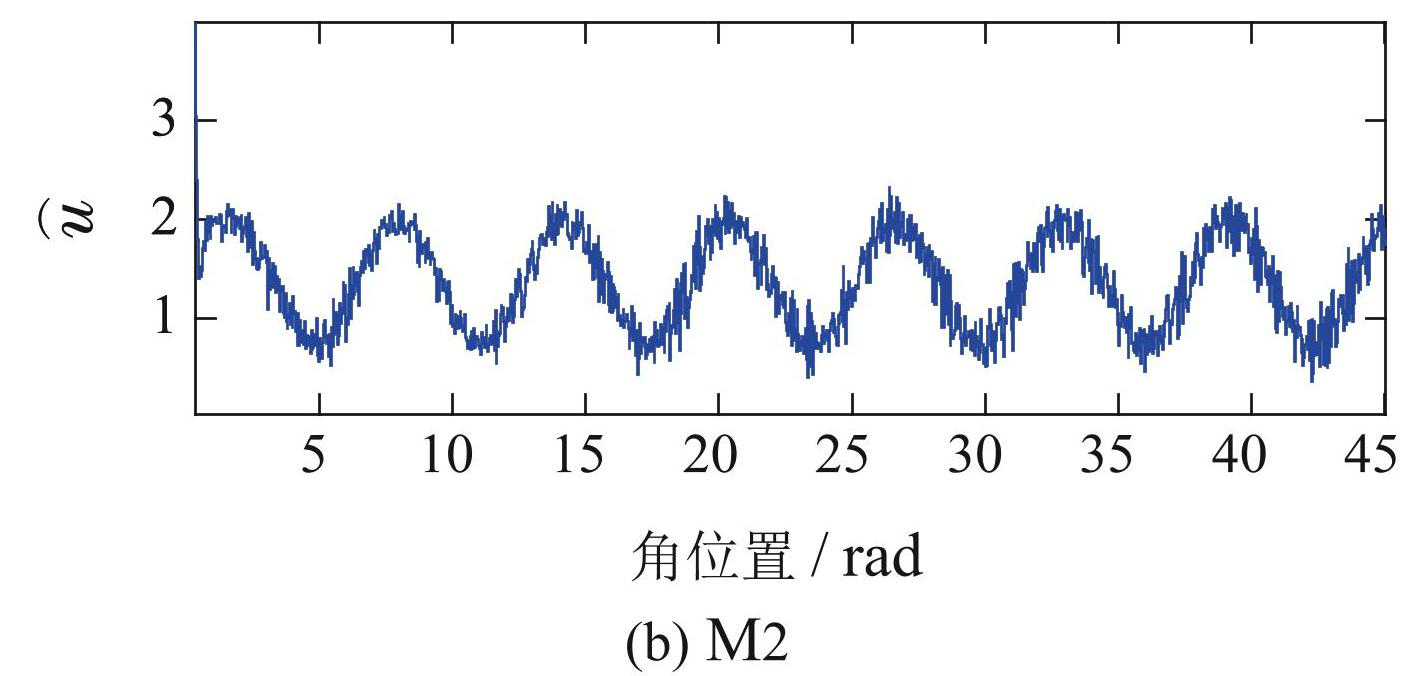
图6控制输入
Fig.6Control input
6 结论
本文针对空间域形式的非参数不确定旋转电机系统,提出了一种基于李雅普诺夫方法的空间自适应全限幅重复学习控制方法,实现了系统角速度对具有空间周期特性的期望轨迹的高精度跟踪. 利用旋转电机的空间周期重复运行特性,设计了空间全限幅学习律对系统非线性不确定动态进行有效补偿,并保证了参数估计值的有界性. 此外,设计了自适应参数估计律估计系统不确定参数,减少控制器设计对系统模型信息的依赖性. 最后,实验对比结果也验证了本文所提方法的有效性.